
July 22, 2026
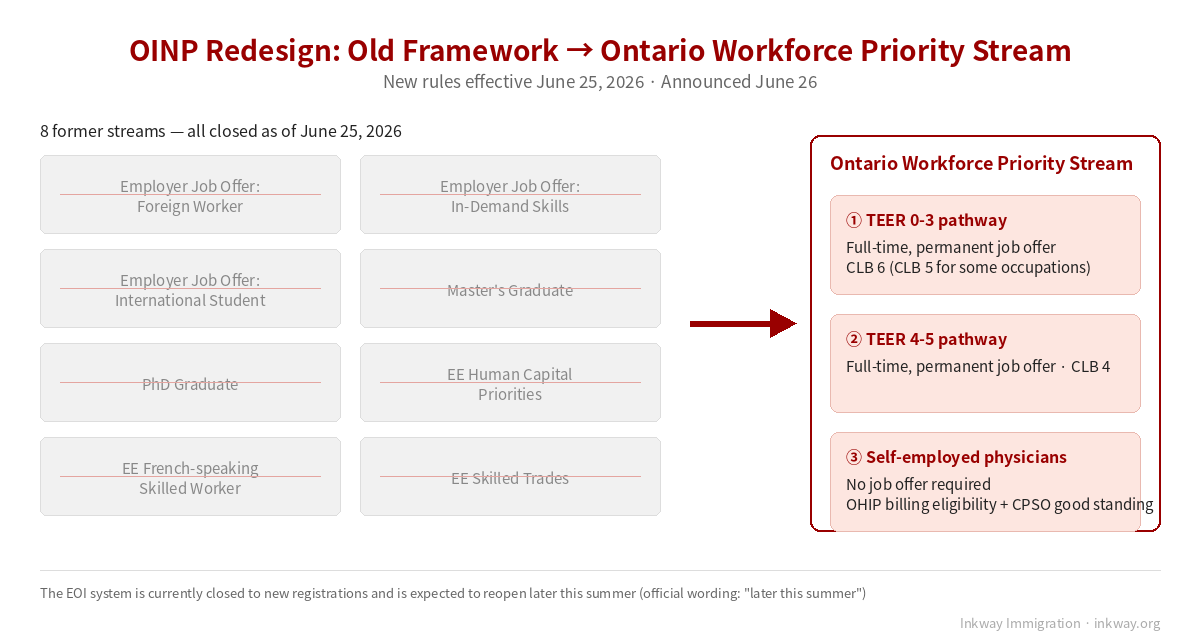
According to Ontario’s official 2026 Ontario Immigrant Nominee Program Updates page, the OINP redesign (Phase 1) took effect on June 25, 2026, with an official announcement following the next day (June 26). The core changes: 8 former streams have been closed and replaced by the new Ontario Workforce Priority Stream; the Expression of Interest (EOI) system is currently closed to new registrations and is expected to reopen later this summer; the new stream runs through three pathways — TEER 0-3, TEER 4-5, and self-employed physicians; and some language and education requirements have been raised, alongside stronger program-integrity measures.
The real value of this news isn’t that “Ontario has one more stream name.” It’s that Ontario is consolidating its pathway logic into something more centralized and more employer-driven, with a much stronger emphasis on genuine job offers, real work experience, language thresholds, and compliance.
What actually changed
This isn’t a minor tweak to existing programs — Ontario has shut down many stream names people were used to. The streams the official update page lists as closed include:
- Employer Job Offer: Foreign Worker
- Employer Job Offer: In-Demand Skills
- Employer Job Offer: International Student
- Master’s Graduate
- PhD Graduate
- Express Entry Human Capital Priorities
- Express Entry French-speaking Skilled Worker
- Express Entry Skilled Trades
This means many applicants can no longer navigate Ontario’s system by the old stream names they’re familiar with. If you’re used to asking “I have a master’s degree, can I go through Master’s Graduate?” or “I have an Express Entry profile, can I wait for HCP?” — the question to ask now is different: do I meet the basic requirements of one of Ontario’s new streams, particularly around employer, work experience, language, and education?
What the new framework looks like: eligibility gates first, not open competition
Under the framework Ontario has currently published, the Ontario Workforce Priority Stream has three pathways, shown below:
① TEER 0-3 pathway
For applicants in TEER 0, 1, 2, or 3 occupations with a full-time, permanent job offer in Ontario. The minimum requirements listed by the province include:
- Work experience — one of the following: 6 months consecutive in the last 12 months in the job-offer position with the job-offer employer; for recent Ontario graduates, 3 months consecutive in the last 12 months; 2 years cumulative in the last 5 years in the corresponding NOC occupation; certain licensed applicants are exempt from this requirement
- Language: generally CLB 6, CLB 5 for certain occupations
- Minimum education: generally a post-secondary degree or diploma
② TEER 4-5 pathway
For workers in TEER 4-5 occupations with a full-time, permanent job offer in Ontario. The minimum requirements listed by the province include:
- 9 months cumulative work experience in the last 2 years in the job-offer position with the job-offer employer
- Language: minimum CLB 4
- Minimum education: Canadian secondary school diploma or equivalent
③ Self-employed physicians
This one is different. Ontario’s official page states that these applicants may be considered for this pathway without a job offer, provided they meet all of the following:
- Good standing with the College of Physicians and Surgeons of Ontario (CPSO)
- Hold a qualifying certificate of registration
- Eligible to bill through OHIP
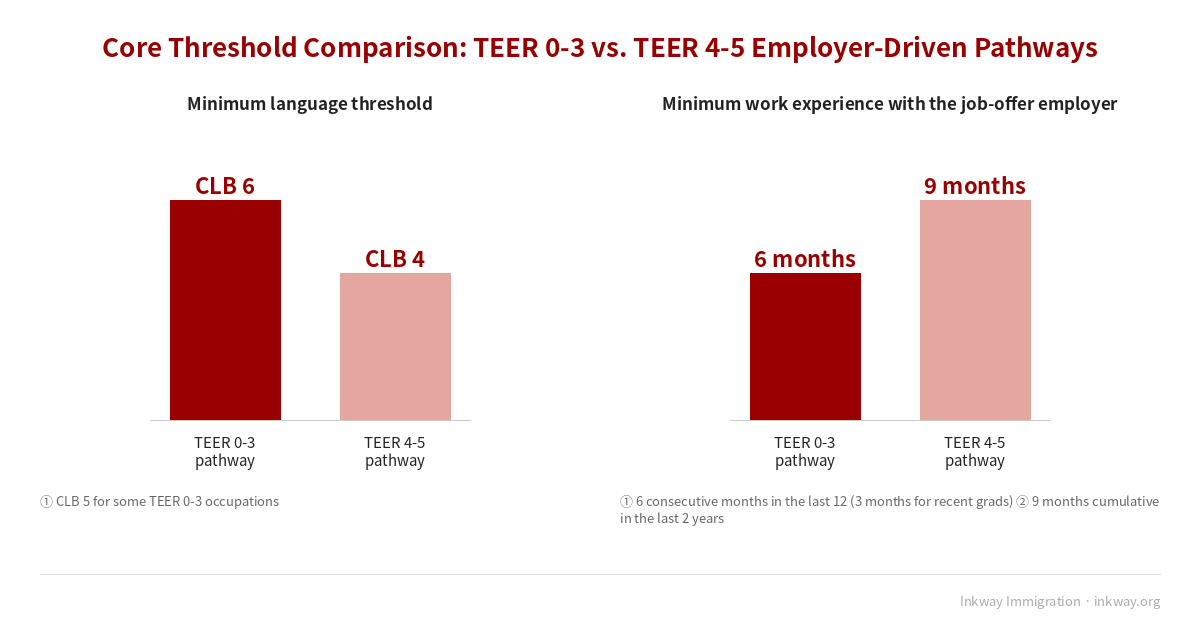
The core dimensions of all three pathways are summarized below:
| Dimension | ① TEER 0-3 pathway | ② TEER 4-5 pathway | ③ Self-employed physicians |
|---|---|---|---|
| Job offer | Required: full-time, permanent Ontario job offer | Required: full-time, permanent Ontario job offer | Not required |
| Work experience | One of: 6 months consecutive in the last 12 months with the job-offer employer; 3 months consecutive in the last 12 months for recent Ontario graduates; 2 years cumulative in the last 5 years in the NOC occupation; certain licensed applicants exempt | 9 months cumulative in the last 2 years with the job-offer employer | Work-experience rules don’t apply; licensing status is checked instead |
| Language threshold | CLB 6 (CLB 5 for certain occupations) | CLB 4 | No language threshold listed on the official page |
| Education threshold | Post-secondary degree or diploma | Canadian secondary school diploma or equivalent | Must hold a certificate of registration recognized by the CPSO |
| Core compliance requirement | Employer must complete registration in the employer portal and submit a compliant job offer | Same as left | CPSO good standing + eligibility to bill through OHIP |
The entry logic has changed
The easiest misread of this news is: “Ontario has a new stream now, so can I apply right away?” In reality, many people aren’t anywhere near the “submit” stage yet, because the province has also made clear:
- The new EOI system is currently closed and is expected to reopen later this summer
- Existing EOIs and job-offer registrations under former streams that haven’t resulted in an invitation will be automatically withdrawn over the coming weeks as the system is updated
- Once eligible, applicants will need to wait for the system to reopen and re-register under the new stream
- Employers who already registered in the employer portal won’t need to create a new employer account, but will need to submit a new job offer / position-approval process
In other words, the real value of this update for prospective clients isn’t urgency for its own sake — it’s the reminder that the first thing to do now is recalculate their own situation against the new rules.
Who should pay the closest attention to this update
1. Anyone who’s been tracking Ontario’s old stream names
If you’ve been watching names like Master’s Graduate, PhD Graduate, Human Capital Priorities, French-speaking Skilled Worker, or Employer Job Offer, the worst thing you can do now is keep interpreting the new pathways through the old entry points. Those names have lost most of their reference value — what actually matters now is whether you can qualify for one of the pathways under the Ontario Workforce Priority Stream.
2. Anyone with an Ontario employer who hasn’t carefully checked the job-offer and experience requirements
Many people hear “I have a job offer, so I can go through Ontario” and assume they’re already close. Under the new framework, what actually needs to be checked is: is the job offer full-time and permanent; what TEER level does the position fall under; is your experience actually “with this employer, in this position,” or just generally related work; do your language and education actually clear the threshold; and is your employer ready to work through the new process. Until those questions are answered, “I have a job in Ontario” doesn’t automatically mean “I have a stable nomination pathway in Ontario.”
3. Anyone who assumed they’d qualify through a master’s/PhD or Express Entry–related Ontario route
The most common trap for this group: feeling like they were “already close,” only to discover after the redesign that the entry point itself has changed. If your strategy relied heavily on Master’s Graduate, PhD Graduate, or an Express Entry–linked Ontario stream, what you need now isn’t to keep waiting for the old stream to return — it’s to quickly determine whether to pivot to an employer-driven pathway, or rework your Ontario strategy altogether.
Five things worth confirming right now
If you want to turn this news into something actionable rather than another update you scroll past, work through the checklist below and fill in your own situation:
| # | Question | Your situation |
|---|---|---|
| 1 | Do you currently have a real, usable Ontario job offer that is full-time / permanent? | Yes ☐ No ☐ Not sure ☐ |
| 2 | Does your occupation fall under TEER 0-3 or TEER 4-5? | TEER: ______ |
| 3 | Does your work experience meet the official “with this employer / in this position / within this timeframe” requirement? | Months qualified: ______ |
| 4 | Do your language score (CLB) and highest education meet the minimum threshold for your pathway? | CLB: ______ Education: ______ |
| 5 | If the EOI system reopens soon, can your employer registration, position documents, and personal file be ready right away? | Ready ☐ Still need to prepare ☐ |
Many people assume they’re stuck waiting for the policy to open. More often, once it does open, what they’re actually stuck on is job-offer quality, proof of experience, language scores, education documentation, or employer cooperation.
Recalibrate, then move
For most people, the issue isn’t the absence of an Ontario pathway — it’s still navigating with an old map while the entry points have moved.
If you’re currently working on an Ontario route, the most useful thing this update can prompt you to do is revisit your job offer, TEER classification, experience, language, education, and how ready your employer is.
To learn more, feel free to message us or reach out directly at info@inkway.org.
Source: Ontario’s official 2026 Ontario Immigrant Nominee Program Updates page (ontario.ca). Last verified: July 22, 2026. Specific eligibility and process details are governed by the latest official releases. This article was reviewed by Shijian Liu, RCIC-IRB (College ID R1053355). Licensing status can be verified at college-ic.ca.